
Understanding the ISO 9001:2015 Documentation Pyramid
The internationally accepted ISO 9001:2015 standard for Quality Management Systems (QMS) places a strong emphasis on efficient documentation to guarantee quality, consistency, and ongoing development. The documentation pyramid is one of the most effective visual aids for comprehending and putting into practice ISO 9001:2015 documentation standards. This blog article explores the levels, significance, and ways that organizations may use the ISO 9001:2015 documentation pyramid to successfully achieve ISO requirements.
What is the ISO 9001:2015 Documentation Pyramid?
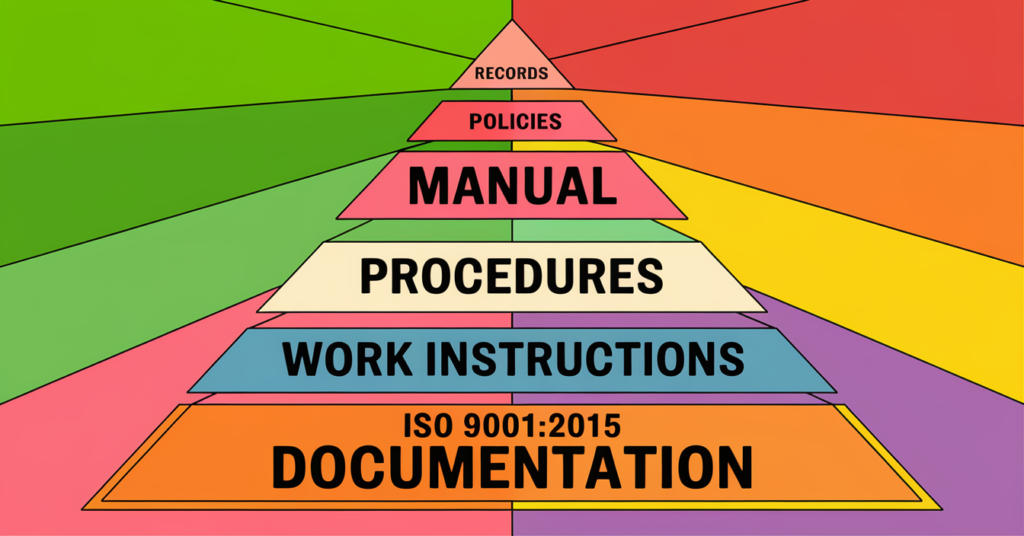
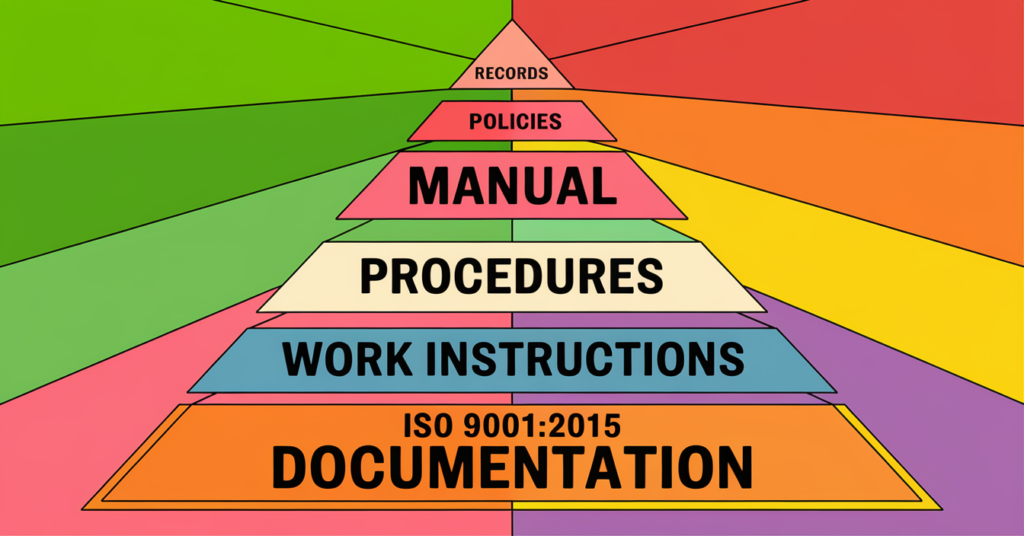
The ISO 9001:2015 documentation pyramid is a hierarchical model that represents the levels of documentation required to implement a robust QMS. It illustrates the relationship between various types of documents and their roles within the system. The pyramid is typically divided into four tiers:
- Quality Manual (Top Level)
- Procedures
- Work Instructions and Guidelines
- Records (Base Level)
- Each layer supports the layers above it, creating a structured framework that ensures clarity, consistency, and accountability.
Layer 1: Quality Manual
At the apex of the pyramid lies the Quality Manual, a high-level document that provides an overview of the organization’s QMS. While ISO 9001:2015 no longer explicitly mandates a quality manual, many organizations still use it to outline their approach to meeting the standard’s requirements.
- Key Elements of a Quality Manual:
- Scope of the QMS: Defines the boundaries of the quality management system.
- Quality Policy and Objectives: States the organization’s commitment to quality and continuous improvement.
- High-Level Processes: Describes the primary processes and their interactions within the QMS.
- Reference to Procedures: Provides a roadmap to detailed procedures and documents.
- The quality manual acts as a guiding document that sets the tone and direction for the QMS.
Layer 2: Procedures
- The second tier comprises Procedures, which define the methods and responsibilities for carrying out key processes. These documents ensure that activities are performed consistently and in alignment with organizational goals.
- Characteristics of Procedures:
- Standardization: Procedures establish a consistent way of working across the organization.
- Clarity: They identify who is responsible, what needs to be done, when it should be done, and how.
- Alignment with Requirements: Procedures address specific clauses of ISO 9001:2015 and organizational needs.
- For instance, a procedure for document control might detail how documents are created, approved, distributed, and reviewed to maintain integrity and relevance.
Layer 3: Work Instructions and Guidelines
- Beneath procedures lie the Work Instructions and Guidelines, which provide detailed, step-by-step instructions for performing specific tasks. These documents are more granular and operational compared to procedures.
- Examples of Work Instructions:
- Operating machinery
- Conducting quality inspections
- Handling customer complaints
- Importance of Work Instructions:
- They reduce variability by guiding employees in performing tasks consistently.
- They are particularly useful for training new employees.
- They support compliance with procedures and overall QMS requirements.
- Work instructions can take various forms, such as text-based documents, flowcharts, or visual aids, depending on the complexity of the task and the audience.
Layer 4: Records
At the base of the pyramid are Records, which serve as evidence that activities have been performed as planned. Records demonstrate compliance with ISO 9001:2015 requirements and provide a basis for decision-making and continual improvement.
Examples of Records:
- Training logs
- Inspection reports
- Internal audit findings
- Customer feedback forms
Key Features of Records:
- Traceability: Records should identify what activity was performed, by whom, and when.
- Retention: Organizations must define how long records should be retained to meet regulatory and business needs.
- Protection: Records should be securely stored to prevent unauthorized access or loss.
Importance of the Documentation Pyramid
- The ISO 9001:2015 documentation pyramid offers several benefits for organizations:
- Clarity and Organization: The hierarchical structure helps in organizing documents systematically, making it easier for employees to find and use them.
- Consistency: By defining roles, responsibilities, and methods at each level, the pyramid ensures uniformity in operations.
- Compliance: Proper documentation aids in demonstrating conformity to ISO 9001:2015 requirements during audits.
- Continuous Improvement: Records and feedback loops enable organizations to identify areas for improvement and implement corrective actions effectively.
Tips for Implementing the Documentation Pyramid
- To make the most of the documentation pyramid, consider the following best practices:
- Align Documentation with Processes: Ensure that documents support the processes rather than creating unnecessary bureaucracy.
- Use Simple Language: Documents should be easy to understand for the intended audience.
- Leverage Technology: Use document management systems (DMS) to create, store, and control access to documents.
- Train Employees: Provide training on how to use and maintain documentation effectively.
- Review and Update Regularly: Periodically review documents to ensure they remain relevant and aligned with organizational goals and ISO 9001:2015 requirements.
Conclusion
The ISO 9001:2015 documentation pyramid is more than just a model; it is a roadmap for achieving an effective and efficient QMS. By understanding and implementing each layer of the pyramid, organizations can ensure clarity, consistency, and compliance, ultimately driving customer satisfaction and continual improvement. Whether you are starting your ISO 9001 journey or seeking to optimize your existing QMS, the documentation pyramid provides a solid foundation for success.
By adhering to this structured approach, your organization can unlock the full potential of ISO 9001:2015, ensuring not just certification but also tangible business benefits such as enhanced quality, operational efficiency, and customer trust.